

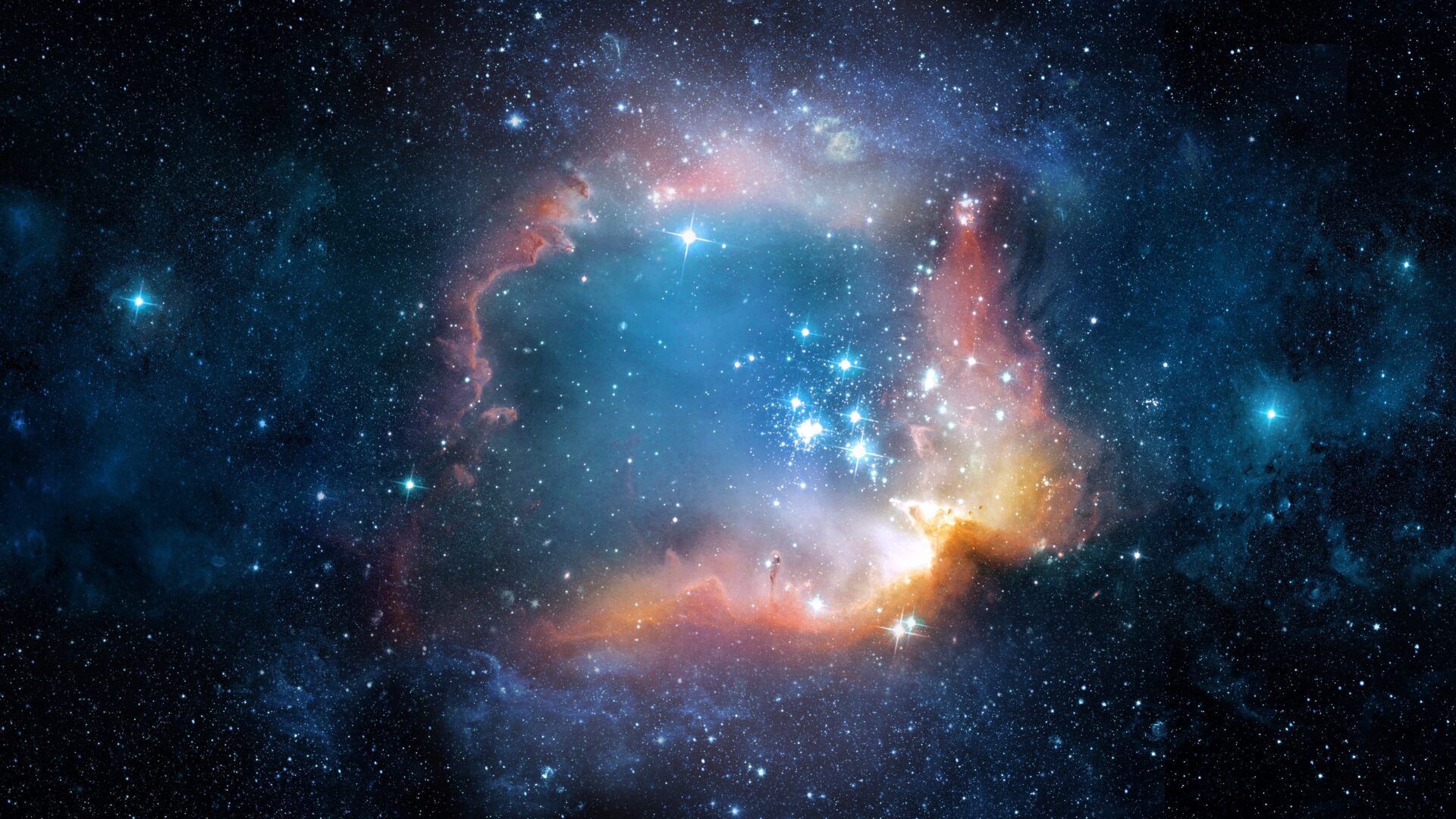
The rate of expansion of the Universe changes dramatically over the years. Scientists suggest that the universe could end much sooner than originally thought. Fear not, it won’t be in the next tens or hundreds of years.
Billions instead of trillions
It has long been assumed that the universe would exist for trillions of years. But a new study has shown that the universe could only last 33 billion years. After that time , everything should cease to exist. This was suggested by research by three Dutch scientists, published in the Journal of Cosmology and Astroparticle Physics.
The study follows a paper published in 2023 by black hole expert Heino Falcke, quantum physicist Michael Wondrak and mathematician Walter van Suijlekom. This trio is also behind the current research. In earlier work, the trio suggested that black holes and neutron stars should evaporate in a process similar to Hawking radiation.
An invisible form of energy
The latest findings are based on studies of dark energy using models from the Dark Energy Survey and the Dark Energy Spectroscopic Instrument. It is thought to be an invisible form of energy that permeates the universe and is responsible for its constant expansion. Scientists have mapped hundreds of millions of galaxies. They’ve discovered that the equation of state of dark energy changes over time.
I’m sure more data will have to be collected to verify everything. The model depends on many variables, and several different combinations of them could still explain the observations, although a negative cosmological constant remains the most likely in their analysis.
 ━━
( Source: NASA / Unsplash+ )
━━
( Source: NASA / Unsplash+ )Neutron star
Scientists have calculated that the Hawking radiation process also works in principle for other objects with a gravitational field. The calculations showed that the evaporation time of an object depends on its density. Scientists were surprised to find that neutron stars and black holes decay in the same time.
They didn’t expect this because black holes have a stronger gravitational field. In theory, this should make them evaporate faster. But according to study co-author Michael Wondrak, black holes have no surface and reabsorb some of their own radiation. And that slows down the process.
The moon and humans
The researchers also counted other things. They wanted to find out how long it takes for the moon and humans to evaporate due to Hawking radiation. They arrived at a figure of 10^90 years. That’s one with ninety zeros. The scientists noted that, of course, due to other processes, the moon and humans could disappear even faster. This is just an estimate based on one of many processes in the universe.
Connecting the disciplines helps
The scientists involved in the research praise their interdisciplinary collaboration. Combining astrophysics, quantum physics and mathematics leads to new insights. This allows the authors of the study to better understand the theory. Walter van Suijlekom hopes that this connection will one day unravel the whole mystery of Hawking radiation. I wish the research team the best in their findings. Unfortunately, we won’t be able to verify any of their claims. Unless humanity goes extinct much sooner through its own doing, the extinction of the universe is far in the future.


 Šárka Cvrkalová
 A. Urban

 O. Müller
