

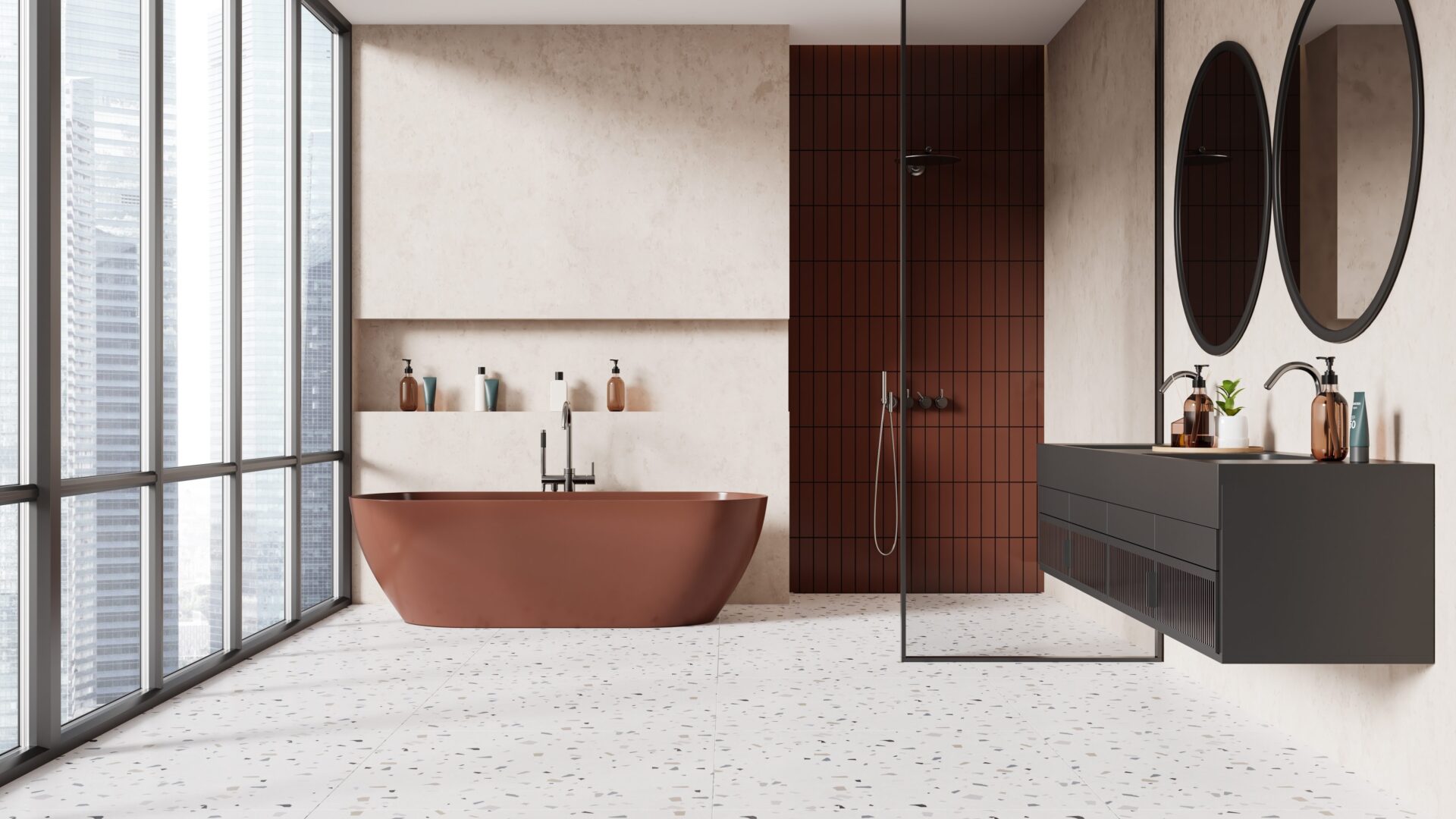
During the communist era, you could find one decorative element in almost every Polish house, but it gradually disappeared over the decades. Recently, however, it has been enjoying a renaissance and is once again returning to interiors as a very popular material whose use goes back far into the past.
Over the last few years, the material terrazzo, also known as terrazzo, has become the talk of the town again. When you hear the word, most Poles associate it with the grey floors of the communist era. Although I did not live through this era myself, I have come across many photographs or historical articles that discuss this material.
Quite surprising is the fact that terrazzo was used long ago in antiquity. With the rising popularity of retro trends, the interest in this building material is also growing, making it much more common in the interiors of houses and apartments. I have to say that in its current form, I would also consider getting terrazzo for my home.
What is terrazzo?
Let’s move back in time along an imaginary timeline. The roots of terrazzo can be found in ancient Greece, Rome, and also in Egypt. The name comes from the Italian terrazza, meaning terrace. It is a composite material that is made from a mixture of cement, water and various stones. However, terrazzo had its most famous era in Italy during the 15th century. Venetian mosaicists used the remains of marble, which they mixed with lime mortar.
The principle was to lay down fragments of marble which were then covered with a binder. Goat’s milk was then used to polish and enhance the colour of the smooth surface. However, the terrazzo we know today is a later invention. In the 18th century it was further refined and became known as ‘Venetian tile’. Well, from the description, one would think that it was nothing interesting, but these skilful men made a fine mixture which gradually began to enjoy the fame of the golden age.
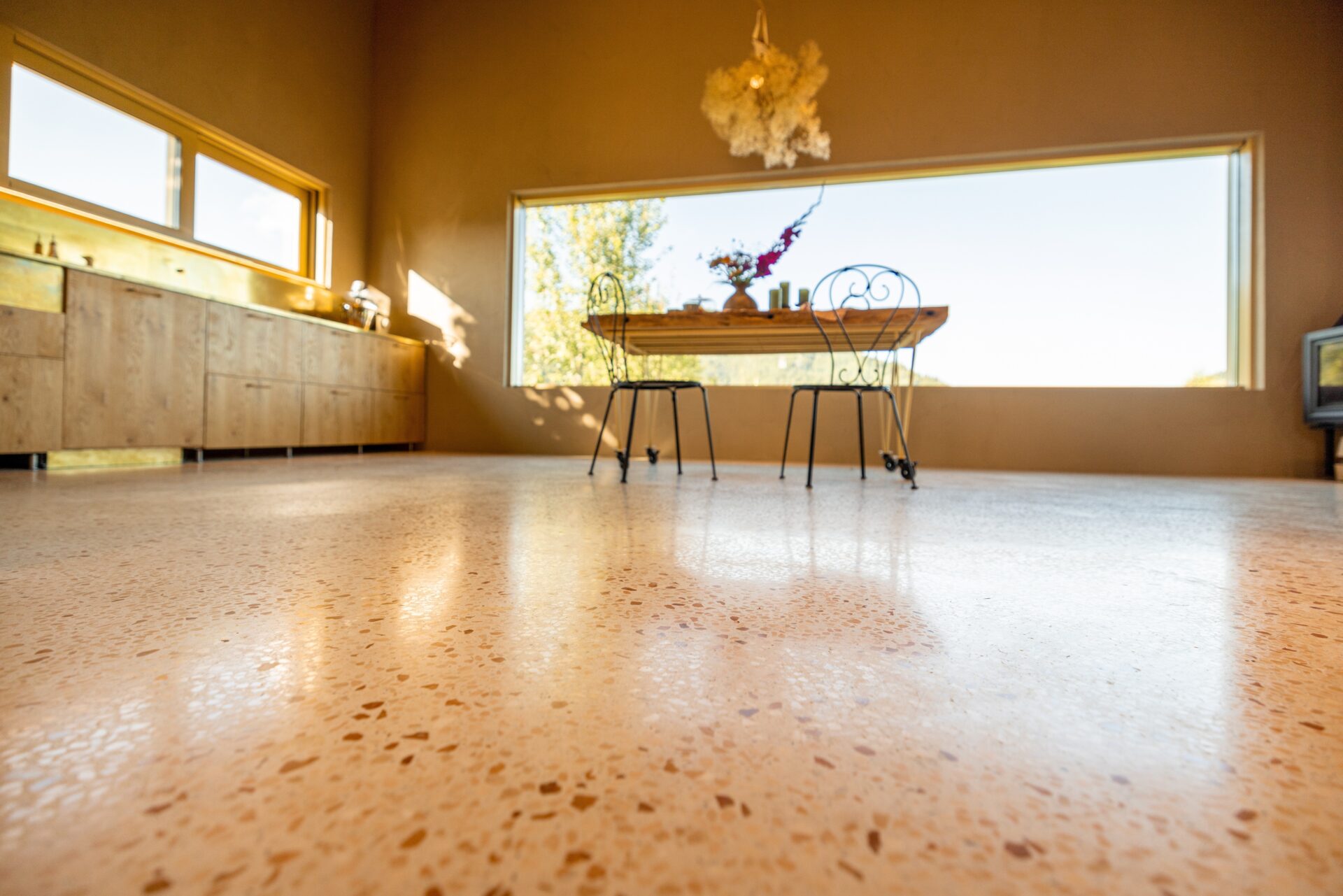 ━━ The typical use of terrazzo is for flooring.
( Source: RossHelen / Shutterstock )
Poland under communism
Terrazzo experienced a great boom in Poland during the communist era. As there was a shortage of materials, an affordable, cheap and durable option was sought. And terrazzo met exactly these requirements, which is why it reached most Polish households almost instantly. The advantage was its versatile use, you could encounter it not only in the form of floors, but also in the form of window sills or tombstones. While functionally there was nothing to complain about, aesthetically it had many criticisms. Generally, Poles considered it a material that was difficult to match and incorporate into the interior, which is why it earned the label “out of necessity”.
After all, let us remember the lamentations of older family members who still recall how difficult it was to find some things. Most homes looked the same in terms of design. I still see remnants of that era today, as grandparents have a hard time giving up things that have accompanied them all their lives.
Modern terrazzo
What everyone had in their home was considered plain and uninteresting in the last century. In its modern form, however, terrazzo is regaining popularity. A number of modern manufacturing techniques have emerged which, combined with colour choice, create the ideal conditions for the material’s rebirth. Today it can be incorporated into almost any environment. The use of terrazzo is not only concentrated on floors, it is also used for window sills, walls, stairs, furniture and even various decorative elements.
Not surprisingly, as in the past, it is valued for its practical properties. It is particularly popular for its resistance to UV rays, abrasion and weathering. At the same time, it does not absorb moisture, does not lose colour and can be created with both smooth and rougher surfaces. The disadvantage compared to the past is the higher purchase price. However, there are cheaper alternatives that are similar to terrazzo.


 Šárka Cvrkalová


 L. Novak

 O. Müller

